
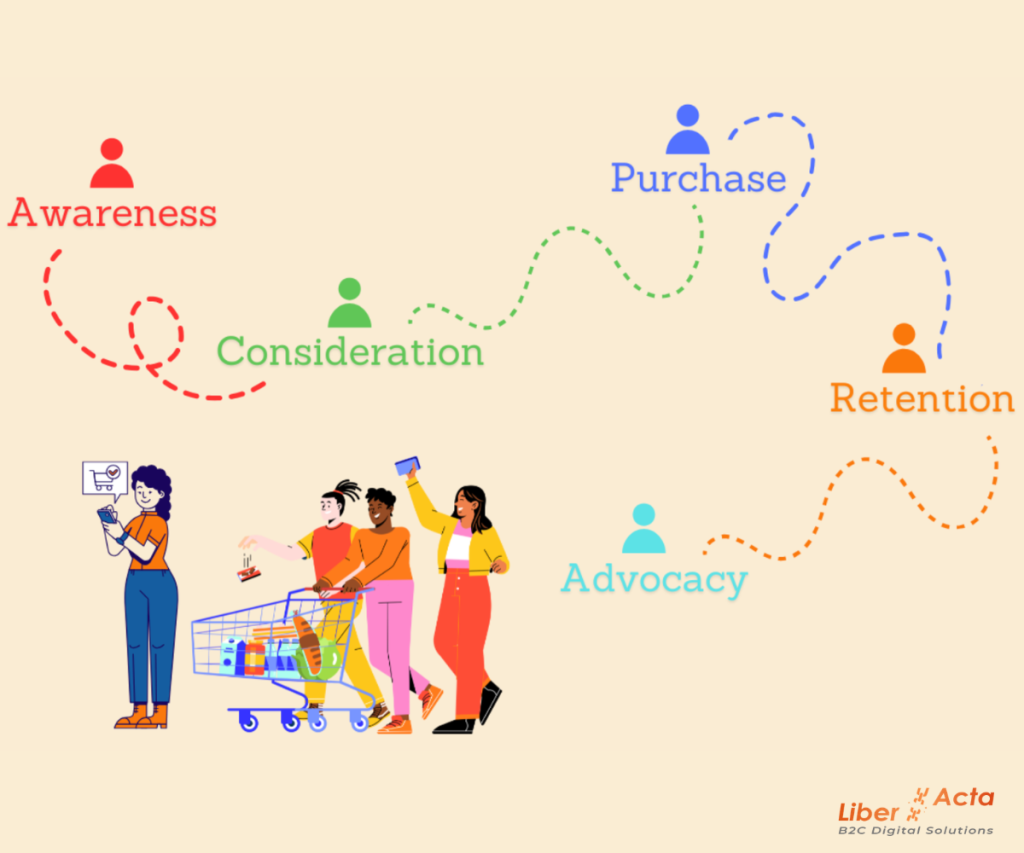
The concept of the Customer Journey made its official debut in 2009 within the pages of the McKinsey Quarterly. At the time, it described a relatively linear purchasing path—a funnel where an unaware consumer entered and a customer emerged. However, in the retail and digital landscape of 2026, that “journey” is no longer a straight line: it is a pulsing, circular, and, above all, predictive ecosystem. Today, mapping the customer journey means more than just monitoring “how and why” someone spends; it means understanding the deep identity of a consumer who no longer seeks just a product, but a value-driven connection. In an era dominated by Artificial Intelligence, loyalty is no longer the final stage of the trip—it is its true center of gravity.
The New Architecture of the Customer Path
While theoretical foundations remain a pillar of marketing, their practical application in 2026 requires a radical update. Let’s explore how the traditional stages have evolved and the best practices to keep them “on point.”
1. Awareness: From Brand Awareness to Contextual Relevance
In 2026, simple “notoriety” is not enough. The average consumer is bombarded by thousands of stimuli daily. The goal is no longer just to be known, but to be relevant at the exact moment of need.
- The Evolution: Thanks to predictive AI, awareness happens even before the customer actively searches. It’s no longer display advertising; it’s contextual marketing.
2. Consideration: The Triumph of Zero-Party Data
In the evaluation phase, the 2026 customer no longer relies solely on reviews (often filtered by AI) but seeks authenticity. Here, the brand must differentiate itself by offering high-value content.
- The Modern Approach: In this stage, collecting Zero-Party Data (information that the customer shares voluntarily) is crucial. If a user shows interest in a product or service, the brand must respond with an exclusive experience tailored to that interest. Consideration becomes a conversation, not a technical price comparison.
3. Purchase: The “Frictionless” Experience and Invisible Payments
The purchasing phase has been revolutionized by technology. In 2026, buying must be frictionless.
- In-store and Online: Whether on a website or in a physical store, checkout must be instantaneous. The goal is to eliminate transaction stress, transforming the act of paying into a fluid and natural gesture.
4. Retention: The Real Engine of Business
This is the heart of modern strategy. Loyalty is no longer a “reward at the end of the race” but a continuous investment.
- Hyper-Loyalty: Today, loyalty is built by offering experiences that money cannot buy. Exclusive discounts or free tickets are “experiential rewards” that create emotional memories. Retention becomes hyper-personalized: the system knows you love nature and suggests a park, or knows you love music and suggests a concert.
5. Advocacy: The Customer as a Media Brand
In the final stage, the satisfied customer becomes an “Ambassador.” In 2026, advocacy is amplified by immersive social media. A customer who enjoys a unique live experience—such as at Centro Sarca—will produce content (videos, stories, reviews) that is worth more than any paid advertising campaign.
Why is the Customer Journey no longer Linear?
It is vital to emphasize that the modern customer path is liquid. A consumer can be in the Advocacy phase for one product while simultaneously discovering a new need (Awareness) thanks to a brand suggestion.
In 2026, we speak of the “Loyalty Loop”: a continuous circle where the Retention phase constantly feeds new phases of Consideration. If you treat your customer well after the purchase, you won’t have to spend again to acquire them (Customer Acquisition Cost – CAC), because they will return spontaneously, attracted by an ecosystem of tailor-made benefits.
Towards a Loyalty Strategy Fit for Business
In conclusion, customer loyalty is the fundamental component of the modern Customer Journey and represents the critical success factor in a saturated market. Investing in integrated and hybrid loyalty programs helps not only to expand the customer base but to drastically improve sales performance.
The customer does not want to be a number in a database; they want to be the protagonist of a story written together with their favorite brand. If you are looking for a partner to turn this vision into reality, you are in the right place!
Contact us at info@liberacta.com or visit our website to request a demo.